Feline High Rise Syndrome in Singapore: How to Protect Your Cat at Home
Every week, cats fall from Singapore’s HDB flats and condos. Here’s what you need to know — and what you can do today.
If you own a cat in Singapore and live above the ground floor, Feline High Rise Syndrome is a risk you cannot afford to ignore.
It’s one of the most preventable causes of serious injury and death for cats in Singapore — and yet it happens every single week, in HDB flats, condos, and landed homes across the island.
This guide explains what Feline High Rise Syndrome is, why cats in Singapore are especially at risk, and exactly what you can do to protect your cat — without blocking the breeze or ruining your view.
The Basics
What Is Feline High Rise Syndrome?
Feline High Rise Syndrome (HRS) is the veterinary term for injuries sustained by a cat that has fallen from height — typically from a window, balcony, ledge, or rooftop. It is not a medical condition in itself, but rather a pattern of specific injuries that vets see repeatedly in cats brought in after a fall.
Common injuries include broken jawbones (often the first point of impact), fractured legs, ruptured tendons, and internal injuries — particularly to the lungs. Falling from as low as the second floor can cause severe trauma. Falling from higher floors is frequently fatal.
A common misconception is that cats always “land on their feet” and survive falls unharmed. While cats do have a righting reflex that helps them rotate mid-fall, this does not protect them from the impact of landing — especially at the heights common in Singapore’s HDB blocks and condominiums.
Why It Happens
Why Singapore Cats Are Especially at Risk
Singapore’s high-rise living environment creates a specific set of conditions that make Feline High Rise Syndrome more likely here than almost anywhere else in the world.
Windows Are Left Open for Ventilation
Singapore’s year-round heat and humidity mean most residents keep windows open — especially in the evenings. NParks and SPCA both report that most high-rise fall cases involve owners who said they “usually kept the windows closed.” A moment’s distraction is all it takes.
Most Singaporeans Live at Height
Over 80% of Singapore’s population lives in HDB flats, many of which are 10 to 40 storeys high. With cat ownership in HDB flats now officially permitted since September 2024, the number of cats living at height has increased significantly — bringing the risk with it.
Abundant Wildlife Distractions
Singapore’s tropical environment means birds, geckos, butterflies, and insects are constantly visible and audible from windows and balconies. A cat in hunting mode will fixate entirely on its prey — and can lean out, lose balance, or leap without registering the danger below.
Cats Fall While Sleeping
Windowsills and ledges are favourite napping spots. A cat in deep sleep can simply roll off the edge. This is one of the most common and heartbreaking causes of high-rise falls — the cat wasn’t even awake when it happened.
The Law
It’s Now a Legal Requirement in Singapore
Since 1 September 2024, Singapore’s Animals and Birds (Licensing and Control of Cats and Dogs) Rules 2024 legally requires all cat and dog owners to take reasonable steps to prevent their pets from being in any place that exposes them to the risk of falling from height.
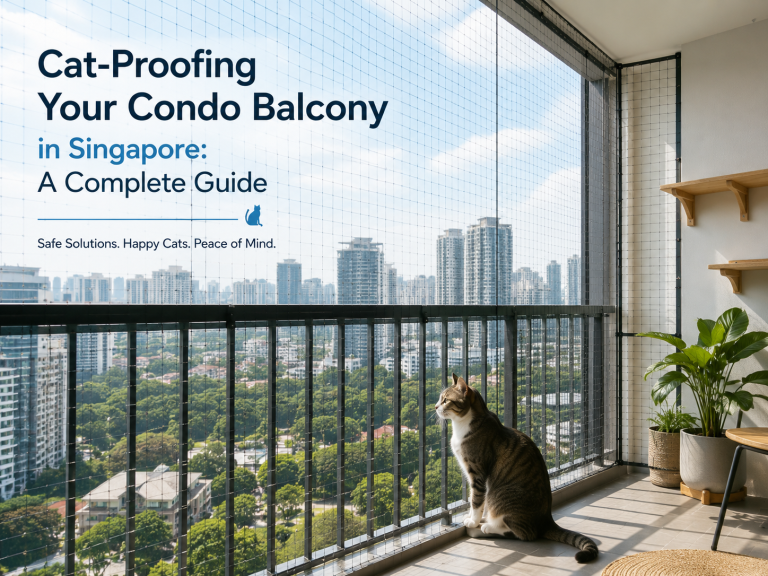
This means installing mesh, grilles, screens, or barriers on windows, balconies, and other openings — in HDB flats, condominiums, and landed homes alike.
Protection Guide
How to Protect Your Cat from High Rise Syndrome
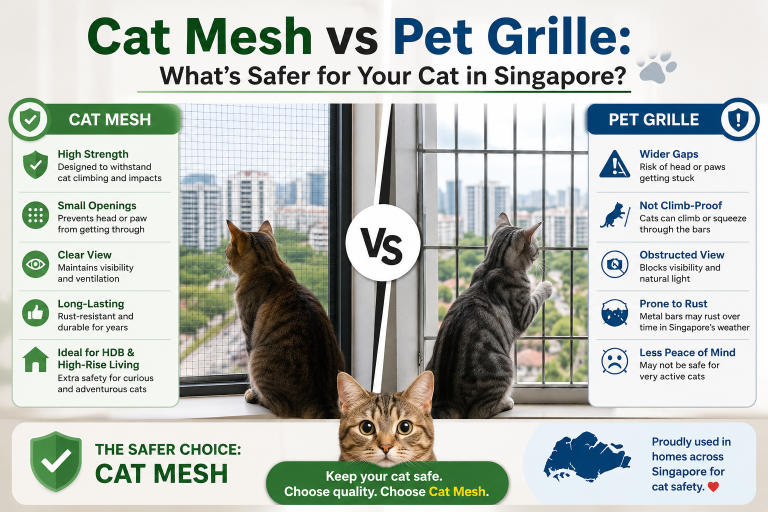
There are several solutions available to Singapore cat owners. Here’s how they compare:
Where to Install
Every Opening That Needs Protection
Don’t protect just one window and consider the job done. Cats will find the one unprotected opening. Here’s every area to secure:
Bedroom Windows
Cats sleep near open windows at night — most falls happen while owners are asleep and unaware.
Living Room Windows
Typically the largest window in the flat — and the one left open most often during the day.
Kitchen Windows
Cats jump onto kitchen counters naturally. An open kitchen window is within easy reach.
Balcony Openings
Railing gaps and the top of the parapet wall are major risk points — especially if your cat is a climber.
Service Yard
Often overlooked — left open while doing laundry, and cats can slip out unnoticed.
Bathroom Windows
Small but accessible — cats are drawn to the warmth and moisture.
Emergency
If Your Cat Does Fall — Act Immediately
Even if your cat appears to walk away from a fall, internal injuries may not be immediately visible. A cat that seems fine after a fall can deteriorate rapidly within hours.
If your cat falls from any height:
- 1
Stay calm and approach your cat slowly — an injured cat may lash out in pain.
- 2
Do not move the cat unless it is in immediate danger — spinal injuries are common after falls.
- 3
Get to a vet immediately — even if the cat appears unhurt. Time is critical with internal injuries.
- 4
If you cannot find your cat after a fall, check the void deck, drain covers, and shrubs near your block.
Singapore 24-hour vet emergency lines: Animal Recovery Centre (+65 6268 0326), Mount Pleasant Animal Medical Centre (+65 6250 2338).
Don’t Wait Until It’s Too Late
Feline High Rise Syndrome is entirely preventable. BlindXpert’s Washable Pet Mesh is custom-measured and professionally installed — keeping your cat safe at every window, without blocking your breeze or your view.